The Beginnings of Music:
The Opposites in the Flute
by Barbara Allen

An Aesthetic Realism Consideration

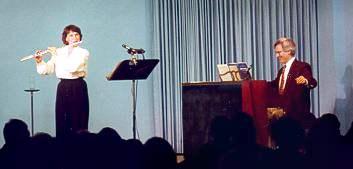
photograph of barbara allen and edward green in concert

PART 1

     Every note, in order to be itself, needs to be played or sung. So along with the note, the musical instrument belongs to the beginnings of music. I am tremendously grateful to Eli Siegel and Aesthetic Realism that I learned from them the reason why people have, since they lived in the caves of France over 34,000 years ago—why they have been impelled to make and play musical instruments. It is because these instruments enable us to put opposites together—ourselves and the world. 

     Every instrument is made from materials to be found in the world—wood, silver, brass, ivory, gold. And every instrument must be played by a person. So when a note is played on an instrument, what we hear and see is a successful oneness of a person and the world. These are, Aesthetic Realism teaches, the first opposites for a person—self and world—and we are trying to do a good job with these opposites from birth.

    We can imagine what it was like when the first person raised a reed to his mouth, blew across it—perhaps to imitate the wind—and heard a sound. The first musician and the musician today have this in common: The instrument he plays is a means of joining himself to the whole world. 

1. What Do Musical Instruments Mean?    

     Since the earliest times there have been three kinds of instruments which can play a note. There are the instruments which are hit—percussion; instruments which are plucked and bowed—stringed-instruments; and instruments which are blown. Now we can ask: What does this mean?                                

     In The Right of Aesthetic Realism to Be Known #93, Eli Siegel writes this: 

Aesthetic Realism ... says there is no music without the simultaneous presence of separation and junction.

And later: 

The continuity and surprise of the world can be found in all the instruments that have been played in all the continents.Separation and junction; continuity and surprise; these are the beginnings of music. When we listen to the three kinds of instruments, we hear in each sound a different way the opposites of continuity and discontinuity are one.  

Listen:

    Here is the drum: [play] It has an explosive, abrupt sound. At the same time drums are suggestive. [Play again] 
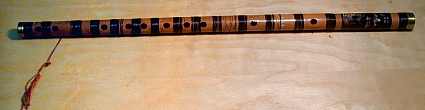
Here is the plucked-string: [play] This sound begins sharply, lingers a little, and dies away. [Play again] The bowed string came later. [Play]   Here is a blown instrument, a Chinese bamboo flute [play three notes] The sound is continuous, but we can hear the separation of one note from another. [Play again, three notes]

chinese flute
Chinese flute

     Sometimes we feel explosive. sometimes we have sharp thoughts which linger and die away. And sometimes we feel more continuous. We are all three. But the way we feel explosive and the way we feel things are continuous very often does not make as much sense as the sounds we just heard. Once in an Aesthetic Realism class Eli Siegel asked me: "Have you ever spent a whole day in one dark mood?" "Yes," I said. Then there can be a day when everything seems to be discontinuous, and from the time we get up till the time we go to bed, we feel like an entire percussion section is going crazy inside us—one thing after another. 

     Boredom and agitation are painful forms of the same opposites all musical instruments put together—continuity and surprise; junction and separation. 

     People have been affected by these opposites for a very long time, and have wanted to put them together well. We can hear this in an English Dance of the 13th century, where the drum, and two wind instruments—instruments which accent separation and instruments that accent junction—play together in a very lively manner. 

     [Play a 30 sec. section with a slow fade—Festive Pipes]

     The next example is predominantly the flute and the drum accompanied by the drone of a reed-box in this selection from the music of India. Though the instruments are in the same family as in the English dance, the sounds are very, even strangely different. You will still be hearing the sharp raps of the drum with the continuous, rather sinuous sound of the flute. 

     [Play 15 sec. of flute and drum, India]

     What this means is that people the world over want to compose the opposites of continuity and surprise through sounds that are joined and sounds that are separate. 

     Why we are so affected by the oneness of these opposites is explained in the chapter "The Aesthetic Method in Self-Conflict" from Self and World where Eli Siegel writes: 

A person is separate from all other things and together with all other things .... The problem that faces a self is how to make its separateness at one with its togetherness. This is the problem which is underneath all others. It can make for agony and it can make for triumph; it can make for painful jumpiness or mobile composure. [Pp. 101, 103]      Most of us have felt quite separate from other people—we have seen our feelings as deeper or very different from those of others, even the person we are closest to. Then there are times we don't see other people's feelings as enough different from ours. In music, however, good sense is made of the opposites of separation and junction. Every time two instruments play together successfully, they can teach us how to solve this dilemma of our everyday lives. Eli Siegel illustrates this with a description of a drum and a clarinet in "The Aesthetic Method in Self-Conflict":  A drum and a clarinet are playing at once. The way they play is plainly different. If the drum tries to play exactly what the clarinet is playing, the result is not good. If the drum plays something too different, wrongly opposed to what the clarinet is playing, the result isn't good, either....Still, it is possible that, as can be seen very often in halls where music is played, the clarinet and drum can play different things at the same time ... and it is possible that the difference make for togetherness or harmony. [Self and World, p. 103]     This is what every person is hoping to feel as we are with another person—that how we are different and the same really add to each other beautifully.

 Continued: for Part 2, click here

Resources on Aesthetic Realism, which I recommend in addition to what's already mentioned on this page, are: (1) The Aesthetic Realism Online Library which has reviews, essays by Eli Siegel, poetry and lectures by Mr. Siegel, books, articles in the press, and The Right of Aesthetic Realism to Be Known. (2) The Web site "Friends of Aesthetic Realism—Countering the Lies" in which students and former students of Aesthetic Realism tell the truth about some of the meanest misrepresentations we've seen. It has wit and satire on it. (3) Links to sites created by persons whose first hand knowledge of Aesthetic Realism and its approach to art, literature, the economy, and life make them important authorities in today's cultural world. (4) Writing by Ellen Reiss, the Class Chairman of Aesthetic Realism, on Robert Burns, Lord Byron, Emily Dickinson; on the Middle East, on Harry Potter as literature; as well as descriptions of the classes she teaches by architect David Salmon, by New York teachers B. McClung and L. Phillips, and by English teacher Leila Rosen. (5) Dr. Arnold Perey's site "Aesthetic Realism: A New Perspective for Anthropology and Sociology."

HOME  |   SITE MAP  |   ECONOMICS  |   TEACHING   |   MUSIC  |   THE FLUTE 1  |   THE FLUTE 2  |   THE FLUTE 3
TERRAIN GALLERY  |   AESTHETIC REALISM FOUNDATION  |   FACULTY  |   THEATRE COMPANY
THE RIGHT OF  |   CONSULTATIONS  |   ELI SIEGEL COLLECTION


logo


Copyright © 2000-2008 Barbara Allen, Aesthetic Realism Consultant